Kamath also said that the new bank, set up by India and four other members of the BRICS grouping, will strive to approve its first loan before end of the current fiscal.

Modi is believed to have signed on Ashok's appointment file before he left for Brazil to attend BRICS Summit, an oil ministry official said in New Delhi.
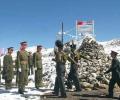
Ren Guoqiang, a spokesperson of the Chinese defence ministry, in a statement said, "Chinese armed forces have also shown a high level of restraint with an eye to the general bilateral relations and the regional peace and stability."

Prime Minister Narendra Modi has emphasised to Chinese President Xi Jinping the need for respecting each other's "interests and concerns, including in the shared neighbourhood", amid worries here over China's bid to increase influence in countries like Bhutan and Sri Lanka.

Setting up Chinese Industrial Parks in India, increased access to Indian products to bridge the ballooning trade deficit besides border issues was expected to figure in Prime Minister Narendra Modi's first meeting with Chinese President Xi Jinping on the sidelines of the BRICS summit.

All the three issues raised by China at the Modi-Xi meeting are either intractable or peripheral to the bilateral relations and suggest conventional methods to placate the other side without yielding much, says Srikanth Kondapalli.
Users jocularly wondered if the name of institutions such as the Indian Space Research Organisation, the Reserve Bank of India and the Board of Control for Cricket in India will be changed.

India is set to press for early disengagement of troops from the remaining friction points in eastern Ladakh at a fresh round of high-level military talks with China on August 14, people familiar with the matter said on Saturday.

The prime minister is all set to break his record of spending most days in the country without travelling abroad.
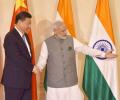
In a sharp reaction to a question about Modi's characterisation of Pakistan at the BRICS Summit in Goa, spokesperson of the Chinese foreign ministry Hua Chunying said China is opposed to linking any country to terrorism.

"Both India and China are victims of terrorism and the region was suffering from the menace. The prime minister said no country is immune from terrorism and on this issue, we cannot afford to have any differences," MEA spokesperson Vikas Swarup told reporters after the meeting.

The S-400 Triumf long-range air defence missile system has the capability to destroy incoming hostile aircraft, missiles and even drones at ranges of up to 400 km.

The turning point in his career was undoubtedly Nepal where he was sent as ambassador and acted with a cool head.

'The message that India has conveyed since the start of this conflict is clear and consistent. It is important to prevent escalation to ensure continued delivery of humanitarian aid and to work towards an early restoration of peace and stability. A peaceful resolution of the conflict through dialogue and diplomacy is the only way forward'

Pakistan Senate has unanimously passed a resolution condemning Prime Minister Narendra Modi's recent remarks in which he described Pakistan as the "mothership of terrorism", calling it a "baseless" propaganda to divert international attention from "atrocities" in Kashmir.
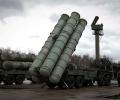
If India signs the deal, it would be the second customer of the prized missile system after China which had struck a $3 billion contract last year.

Prime Minister Narendra Modi this month will be undertaking one of the longest ever abroad visits by an Indian head of government in recent times. He is scheduled to be on a nine-day, three-nation visit to Myanmar, Australia and Fiji from November 11 to 19. Later in the month, he will be in Nepal to attend the South Asian Association for Regional Cooperation summit on November 26-27.
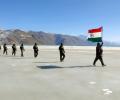
Indian troops are defending every inch of the border with China and not even a single inch of land has been taken over by the neighbouring country in recent years, Ladakh Lt Governor Brig (retd) B D Mishra said on Thursday.

Earlier, Modi met Jinping seperately and the two leaders concurred there had been a perceptible improvement in bilateral relations.

Modi said India's contribution to global economic growth and prosperity underlined its commitment to 'Building Consensus for Fair and Sustainable Development', which is the theme of the summit.
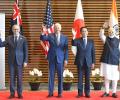
Chinese and Russian warplanes on Tuesday conducted joint air patrols over the Sea of Japan, the East China Sea and the West Pacific Ocean as the leaders of Quad held their in-person summit in Tokyo, in an apparent attempt to send a message of unity between Beijing and Moscow.
Russia has almost completed the delivery of major components of the second regiment of the weapon systems.

Chinese Foreign Minister Qin Gang reiterated that the situation at the India-China border is generally stable and both sides should consolidate the present achievements and strictly abide by the relevant agreements while pushing for further cooling and easing of the conditions for sustainable peace and tranquillity at the frontier.

In the wake of reported incursion attempts by China, India on Wednesday said such incidents take place due to difference of perception about boundary and leaders of both the countries are in talks to resolve the issue.

President Xi said that the Chinese side is ready to work with the Indian side to carry forward the fresh impetus of bilateral relations.

India scripted history as the ambitious third Moon mission of the Indian Space Research Organisation (ISRO) touched down on the Moon's south pole, propelling the country to an exclusive club of four and making it the first nation to land on the uncharted surface.
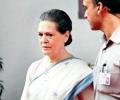
The past three weeks have demonstrated that the Congress is still to recover from the drubbing it received in Lok Sabha elections, says Rediff.com contributor Anita Katyal

The Indian government's decision in 2012 to allow foreign direct investment in civil-aviation sector up to 49 per cent has enthused new airlines to launch their operations and capitalise on country's 1.2 billion population, a pre-statement to the Global Aerospace Summit said.

"The basic idea is that India would like to continue to be the most beautiful woman wooed by all men, notably the two strongest in the house, US and China," the article titled 'Indo-US strategic distrust stalls LSA signing'.
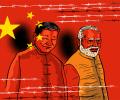
'Given the sharp increase in oil prices, a mounting problem for the 2nd and 4th largest importers like China and India -- the Qingdao meeting is likely to push for the large energy producers (Russia and the Central Asian Republics) and energy consumers (China and India) to arrive at some understanding for mutually beneficial outcomes,' notes Srikanth Kondapalli.
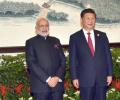
Prime Minister Narendra Modi and Chinese President Xi Jinping have agreed to make efforts to put India-China ties in the "right direction" and to "respect and accommodate" each other's concerns to avoid "impedance" relations, a top Chinese diplomat said on Tuesday.

The regular membership of India and Pakistan, who are observers of the Shanghai Cooperation Organisation, has been approved and they will be inducted formally next year.
The Bharatiya Janata Party on Thursday scoffed at reports that it was trying to lure MLAs of other parties to form government in Delhi, saying the party has never indulged in horse-trading and will not do so in future.
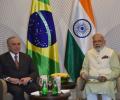
Prime Minister Narendra Modi also thanked Brazilian President Michel Temer for "understanding India's aspiration" for membership of the Nuclear Suppliers Group.

Prime Minister Modi will hold bilateral meetings with President Paul Kagame, delegation-level talks and meetings with the business and the Indian communities, a statement from the Prime Minister's Office said.

In spite of irritants and hiccups in the relationship, a few deliverables are expected of the prime minister's visit to China, says Rup Narayan Das.

The Chinese envoy said that the India-China bilateral ties can't take the strain of another Doklam episode
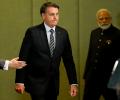
As someone with nostalgia for the good cheer and friendly feelings of Brazilian people, former Ambassador to Brazil B S Prakash can only hope that when they see on their TV screens their President being feted on Rajpath, they will sense India's goodwill for Brazil.

From United States President Donald Trump and Russian President Vladimir Putin, Modi met them all.
'The mood in Beijing is already nervous and feverously watchful.' 'Developments in China will be scrutinised as intensely and nervously as the ones in Washington,' says Claude Smadja.
